posts / Compliance with EU values
Compliance with EU values:
trial run with ESN?
28 May. 2026 — The Europe of Sovereign Nations party risks being banned for failing to uphold EU values, a bombshell development in the usually quiet world of European parties. Is this acceptable? Is this censorship?
Note: the post below is the unrolled version of a hot-take thread available here, with minor adjustments.
Legal considerations for values compliance
Firstly, who are we talking about? European political parties are EU-level political parties that often look like "parties of national parties". They are extra-parliamentary bodies, separate from political groups of the European Parliament. Some have existed since the 1970s, and they were officially recognised in the 1992 Treaty of Maastricht.
In 2004, European political parties started receiving European public funding and, in 2007, European political foundations followed suit (to the tune of half a billion euros since then). In 2014, Regulation 1141/2014 created a monitoring body, the Authority for European political parties and European political foundations (APPF).
Starting in 2017, European parties and foundations could register with the APPF and obtain European legal personhood if they met specific criteria. Under Regulaition 1141/2014, this has become a requirement to receive European public funding. The most restrictive criteria was to be represented with MEPs/MPs/votes in a quarter of EU member states.
However, the Regulation also introduced a requirement for European parties and foundations to "respect the values on which the Union is founded, as expressed in Article 2 TEU." A European party or foundation in breach of this requirement could be deregisted, and subsequently lose its European public funding.
Importantly, this obligation only applied to European parties and foundations themselves, and not to their member parties or organisations. As a result, when Hungary veered to illeberalism, the European People's Party (EPP) did not risk deregistration in relation to its member Fidesz. As a result, while Fidesz was suspended in 2019, it was not expelled, and only left the EPP in 2021. The EPP never lost any of its European public funding. In 2024, Fidesz joined the Patriots.eu, which has likewise been funded by European taxpayers' money, despite Hungary being described by the European Parliament as being no longer a democracy.
Notably, during the time when Regulation 1141/2014 was in force, the mechanism to respond to non-respect for EU values was never initiated. Actually, it wasn't until 2023 that a sanction was imposed by the APPF on a European party.
In 2021, European legislators included in their periodic report on the implementation of the framework on European parties a call to "clarify that respect for EU fundamental values should apply to both the European political party itself and its member parties". The European Commission followed this request, and included the provision in its recast proposal in late 2021. Discussions took four years to complete and, in December 2025, Regulation 2025/2445 entered into force.
The new Regulation 2025/2445 now states, in its section on EU values, that European parties and their foundations "should also ensure that their member parties and member organisations observe those values", giving a legal basis for the APPF's recent report mentioned in the Politico article.
The compliance verification process
Is this censorship of specific political ideas? Actually, the Regulation is very careful — both the current one and its predecessor — and includes references to guiding principles, as well as a mix of political-admnistrative process with clear safeguards.
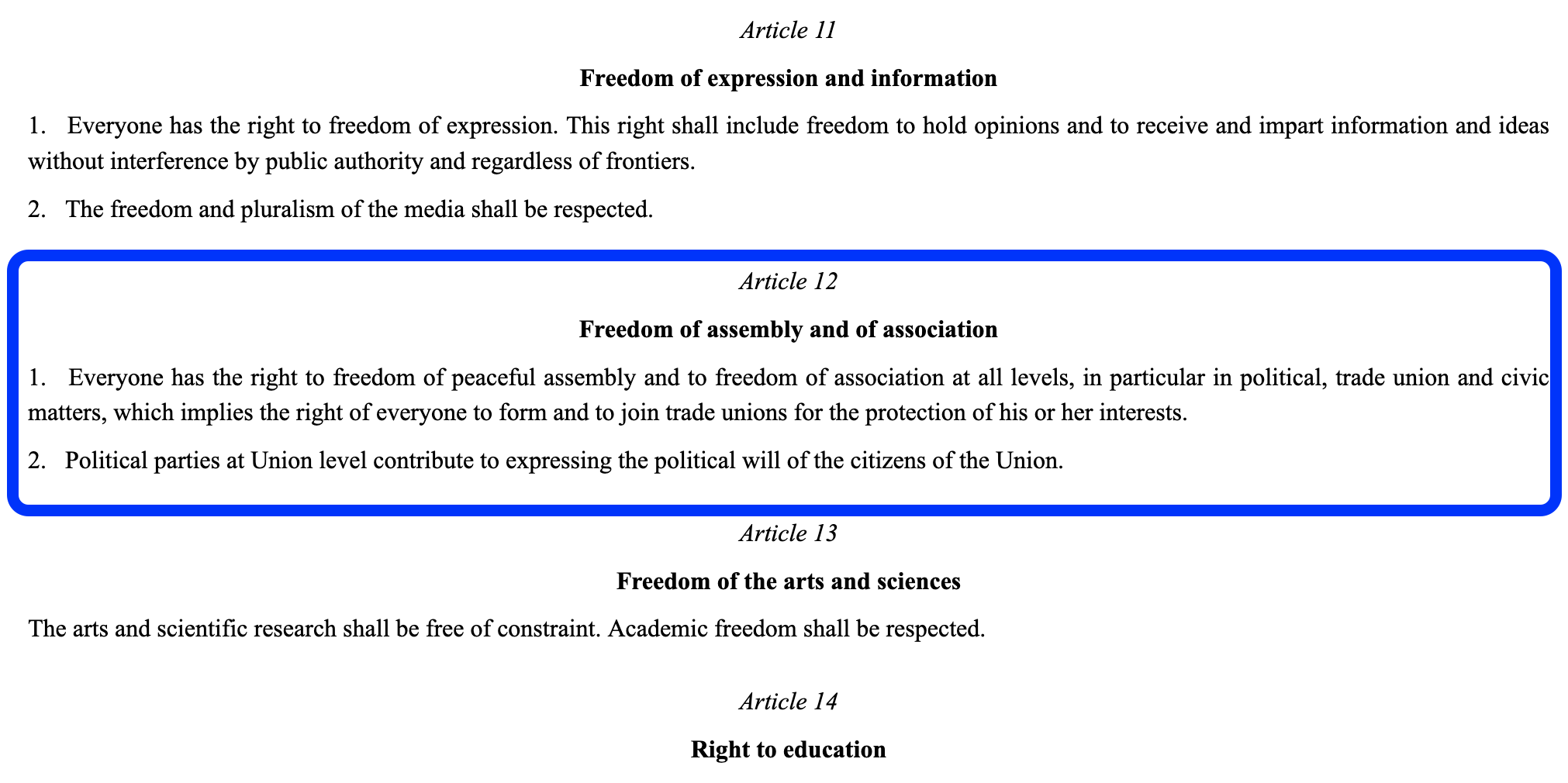
Firstly, not only does the Regulation refer to the Charter of Fundamental Rights of the European Union, but it explicitly says that removal decisions "should fully respect the Charter" and "should be taken only in the event of a manifest and serious breach of those values". For the record, the Charter has the same legal status as EU treaties, and enshrines both the "right to freedom of peaceful assembly and to freedom of association at all levels" and the role of European parties.
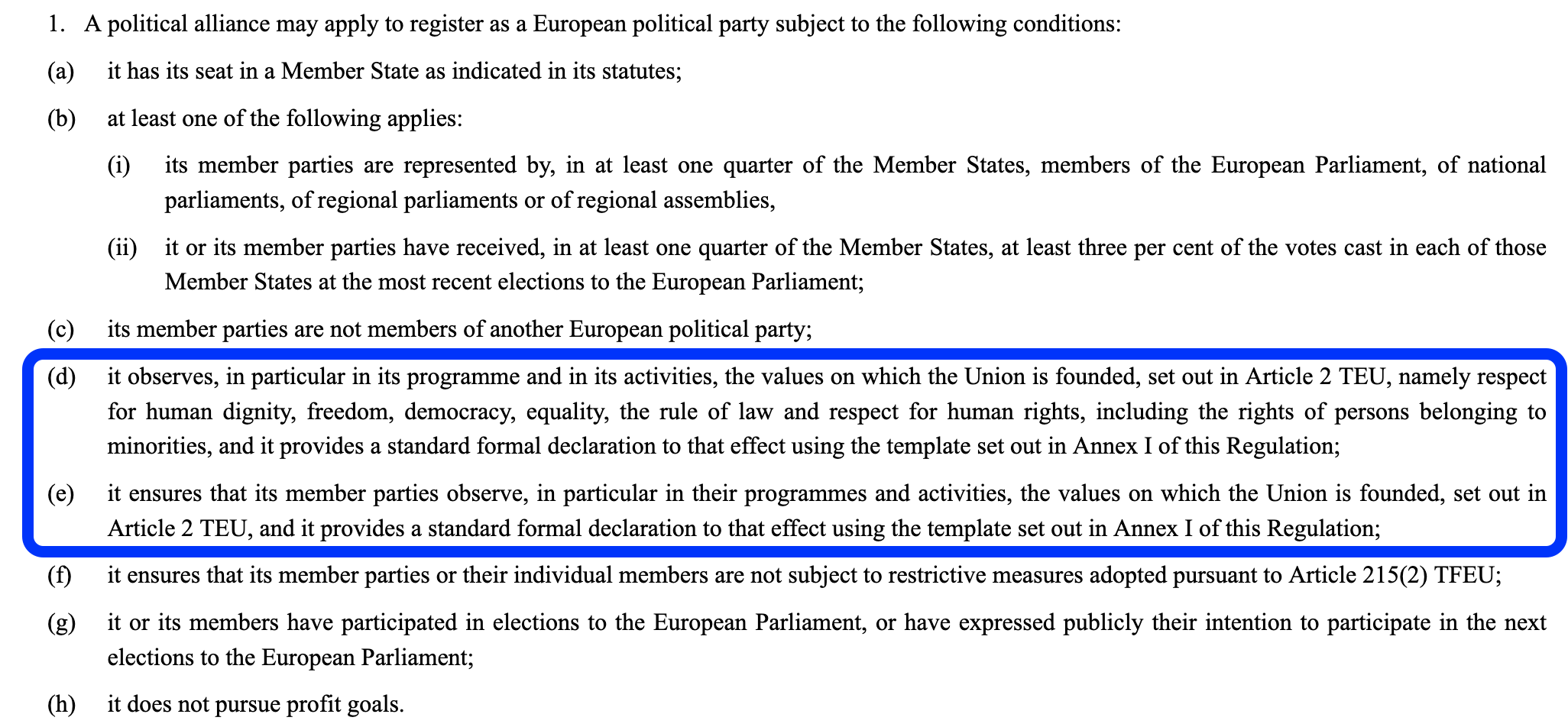
The process for verification/removal is also purposefully made long and complex. First, nothing substantial is required of European parties or foundations or their members at the registration stage: all they need to do is fill in a standard form saying they observe EU values. What are EU values? Set out in Article 2 of the Treaty on European Union, they include "respect for human dignity, freedom, democracy, equality, the rule of law and respect for human rights, including the rights of persons belonging to minorities". Nothing special, but the basis for democracy.
Then, compliance with EU values is excluded from the framework on sanctions: non-compliance leads straight to deregistration, which makes it a "nuclear option" preventing this from being used lightly. Non-compliance is not something you get punished over: if you do not comply, you're out. Note that a similar situation in practice prevented European parties from being sanctioned when a national party failed to display the EU party logo on its website in a clear, user-friendly manner, which most of them did. The sanction (loss of public funding) was far too strong and never applied. This was amended in the new Regulation.
Verification itself must be initiated by one of the three responsible EU institutions: either the Parliament, Council or Commission ask the APPF to verify compliance. Citizens can make "a reasoned request" to Parliament to ask for a verification. As an administrative body, the APPF itself cannot initiate a verification process; however, if it becomes aware of "facts which cast doubt on compliance", the APPF informs the institutions to enable them to lodge a request for verification. Two months after notification, the process lapses. What it is interesting here is the different latitude given to each actor: institutions can choose to lodge a request, either by themselves or following a notification by the APPF. However, once the APPF is aware of "facts", it "shall inform" the institutions — it has no agency and cannot ignore facts, avoid political bias. Since European parties must also follow national law in the member state where they have their seat, the member state in question can also place a "duly reasoned" request for verification. This concerns mostly Belgium (9 parties), but also France, Germany and the Netherlands (1 each).
When a request for verification is placed, the APPF must notify the European party or foundation without delay and "invite it to submit its observations and give it the opportunity to introduce measures to remedy the situation". The one-month deadline can be extended. The Regulation does not provide details about possible remedial measures — would a stern warning to the offending national party/ies be sufficient? would separation work? This is left to European parties or foundations to propose.
Once the deadline lapses or observations/measures are submitted, the APPF submits them to the "Committee of independent eminent persons" for its opinion. Note that, once again, the APPF has no substantial role: it gets the request for verification, notifies the entity, gets a response. The Committee is made up of six experts, two nominated by each of the three institutions — no role for the APPF. Experts are "selected on the basis of their personal and professional qualities", independent, and don't take instructions from institutions, member states, or anyone. They also cannot "hold any electoral mandate, be officials or other servants of the [EU] or be current or former employees" of European parties or foundations. Terms are not renewable. So far, experts are mostly professors or former civil servants and diplomats.
The problem is that appointments, to be made within six months of the first parliamentary session after EU elections, seem a low priority for EU institutions. After the 2019 elections and the first session in July of that year, Parliament didn't nominate its members until April 2020. Likewise, after the 2024 elections, the Council nominated its Committee members in May 2025. Worse, the Commission only appointed its members in 2023 (four year after the 2019 elections), and it still hasn't nominated its new slate.
The Committee has two months to formulate an opinion. The APPF takes it into account and makes a "duly reasoned" decision. This decision is then shared with the European Parliament and Council (not with the Commission). A removal only takes effect if these institutions do not oppose within three months.
Finally, another safeguard is that verifications (or a notification by the APPF to the institutions) cannot take place within two months of European elections.
The process is therefore heavily guarded: the decision (by the APPF) is administrative, but the process is initiated by political bodies, duly reasoned at every step, informed by independent experts nominated by several institutions, and political institutions can veto the final decision. And, presumably, European parties and foundations deregistered can appeal the APPF's decision before the Court of Justice of the European Union, as when the General Court annulled a sanction against ID Party last year.
Final considerations
Of course, criticism will never be avoided: those who oppose a technocratic, independent, and expert-based decision (APPF/Committee) will also oppose a decision made by political bodies (EP/EC/EUCO) as politicised and biased. In essence, those targeted simply oppose the process itself. In this sense, it is not surprising that European parties on the (far-)right (ECR, Patriots, ESN) criticised the reference to Art. 2 in this year's implementation report, warning of "politically driven interpretations" and "ideological standardisation".
Overall, since the process has never been trial-ran, the Committee of Independent Eminent Persons has never gathered, and remedial decisions have never been considered, there is a lot of new ground to be broken, and very little certainty regarding how institutions will choose to behave.
One aspect that can already be discussed is that of transparency. Opinions by the Committee are to be made public (Art. 16.3). Vetoes by Parliament or the Council have to be made public (Art. 13.11). Decisions on sanctions by the APPF have to be made public (Art. 39.1). However, there does not seem to be a provision to make public the "facts" that the APPF would share with the three institutions (as just happened), and it is unclear whether the removal decision to be published in the Official Journal of the EU would contain all the relevant details of the case.
In addition, side consequences to watch out for include:
- the deregistration of a party also means that of its political foundation, so the Sovereign Foundation is on the chopping block; and
- since public funding is split between European parties, removal means more funding for others.
Finally, another key question, especially in light of the recent elections in Hungary and the accusations of disinformation and foreign interference against Fidesz, is whether the Patriots.eu will also be looking at a similar verification procedure.