posts / The Director of the APPF
The Director of the APPF:
international man of mystery
— Louis Drounau, EDCS founder
28 Sept. 2026 — The new Director of the APPF took up his position on 1st September; here is what you should know about his job.
On 1st September 2026, the Authority for European political parties and European political foundations (APPF) welcomed Philippe Musquar as its new Director, only the third in the institution's history. On this occasion, let's take a moment to look at the Director of the APPF: their appointment, role, and challenges.
Limited visibility
Along with its institution, the position of Director of the APPF remains rather new, having been only ever held by two office-holders before the recent appointment: Michael Adam, of Germany, between 2016 and 2021, and Pascal Schonard, of France, between 2021 and 2026. Practice is therefore limited, and compounded by the limited publicity given to the APPF and its actions.
In a previous post, we described how the APPF only had a single social media account, a Twitter account opened in 2022, and how its output had consistently decreased over time, with fewer than one message per month since 2025. Most messages also relate to the APPF's yearly school competitions or the receipt of application documents. As of late September, the APPF's most recent message dated back to May, meaning no communications had taken place either upon the departure of Mr Schonard or the arrival of Mr Musquar.
The website of the APPF does not have a news section or calendar providing information on the actions of its Director, and the page dedicated to the Director is limited to a short, albeit welcome, biography.
Role of the Director
The role of the Director is described in Article 8 of the APPF's founding document, recast Regulation 2025/2445, which replaced Regulation 1141/2014 in late December 2025.
In its 2021 recast proposal, the Commission only marginally amended Article 8, which describes the APPF, its organisation, and its powers. On the one hand, as a result of the recast process, whereby the co-legislators can only amend text modified by the recast proposal, the Council and Parliament were unable to propose amendments to this article; on the other, Parliament's 2021 implementation report, which preceded the Commission's recast, did not contain reform proposals impacting the Director. Likewise, a 2019 amendment had only added limited details regarding conditions of employment.
This role includes important decisions for the democratic life of the Union.
The Director holds the primary responsibility within the APPF: they represent the agency and take all decisions on its behalf (Art. 8.2), and are responsible for the use of financial appropriations made to the APPF (Art. 8.7). This role includes important decisions for the democratic life of the Union, including the registration and de-registration of European political parties and foundations, verifications that these entities respect their legal framework, the power to sanction them if needed, and ensuring transparency both on the APPF's work and on registered entities.
Beyond this, however, the Regulation does not provide any specific details, giving the Director broad latitude to carry out their work.1 The Regulation only mentions that the Director is assisted by staff that they manage (Art. 8.5), that the Commission, Parliament and Council (the "appointing authorities") may assign them other tasks, provided this does not conflict with regular duties (Art. 8.3), and that the Director is responsible for submitting a draft budgetary plan (Art. 8.7) and an annual report (Art. 8.10), both of which are made public.
In their duties, the Director must be independent and "neither seek nor take instructions from any institution or government or from any other body, office or agency" (Art. 8.3). Likewise, as for the verification procedure, the recruitment process provides guardrails against external influence to protect the democratic process.
Appointment process
First of all, the Director is appointed for a five-year mandate, which is a usual duration for agency heads, and cannot be re-appointed; this avoids the temptation for office-holders to curry favours to ensure their re-appointment.
Secondly, the appointment is made jointly by the three appointing authorities, in order to avoid the Director being beholden to any one of them. Following an open call, these institutions' Secretaries-General form a "selection committee", which makes a recommendation, based on candidates' "personal and professional qualities", and the leaders of the institutions officially appoint them.2 Likewise, the Director may only be dismissed by a joint decision of at least two of the three appointing institutions, and following a report by the selection committee.3
Thirdly, the Regulation imposes limitations on the eligibility of applicants. In particular, the Director cannot be a member of the European Parliament, hold electoral mandates, or be a current or former employee of a European political party or foundation. Finally, the Director cannot have conflicts of interests between their position as Director and any other official duties.
Appointments in practice
As we have seen, there have now been three directors appointed. On the one hand, this remains a limited pool; on the other, it starts being enough to capture recurring characteristics.
The first director, Michael Adam, was a lawyer from Germany. According to the limited archived bio provided by the APPF, he had previously worked for the European Commission; he now works for the European Parliament. Mr Adam had studied law in Germany, Spain, and Switzerland.
The second director, Pascal Schonard, was a lawyer from France. According to his archived bio, he had previously worked in a law firm, as a public prosecutor, a civil servant for the European Commission, and in the cabinet of the Secretary-General and the Legal Service of the European Parliament. Mr Schonard had studied law in France and Germany, graduating from the École nationale d'administration (ENA).
The current director, Philippe Musquar is a lawyer from France. According to his bio, he had previously worked for the Commission (1989-2005) and the European Parliament (2005-2026), including in relation to customs, international trade, agriculture and fisheries. Mr Musquar had studied law in France and Belgium, and holds diplomas from Sciences Po and the College of Europe in Bruges.
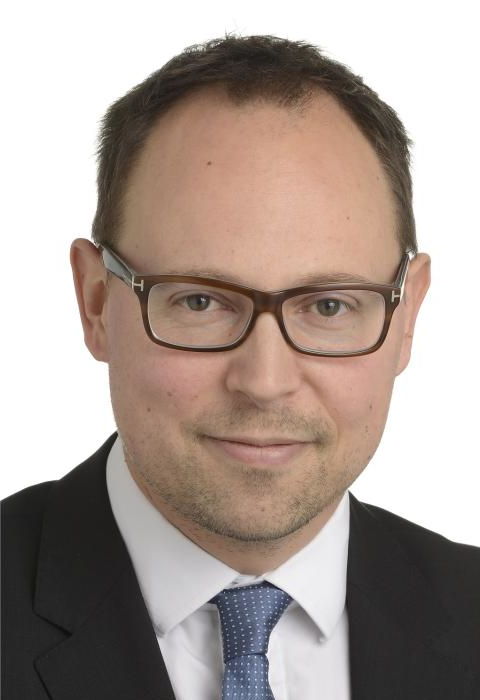
Michael Adam
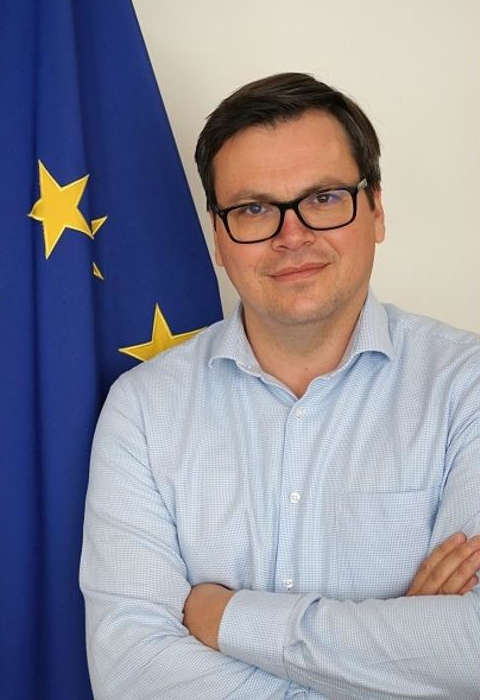
Pascal Schonard
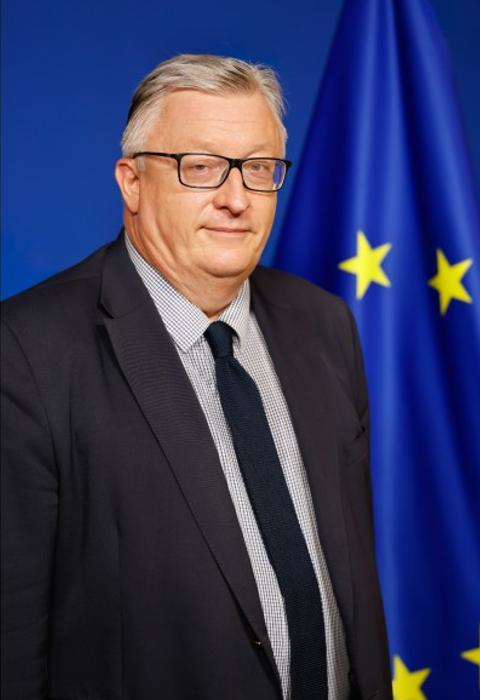
Philippe Musquar
© European Union, 2026
A salient element is nominees' uniformity.
We will not comment on the personal or professional qualities of these nominees. However, a salient element is the uniformity of their profiles: lawyers, male, from Western Europe, educated in Western Europe, having worked for the European Commission and the European Parliament. By contrast, none of the biographies mention previous experience in party politics, party regulation at the national level, or experience in the support of democracy, either European or national. Is this a bias of the selection committee? Is this the result of a limited pool of candidates? This is difficult to say.
In addition to a degree, the job opening requires "at least 15 years of relevant professional experience [...], of which at least 3 in a position with management or equivalent coordination responsibilities", as well as knowledge of the regulatory and financial framework of European political parties and European political foundations, of the Financial Regulation, of the European Union institutional framework, and of English or French, as well as the ability to develop and communicate a vision, management and leadership skills, and experience in communication and networking. This description is therefore heavily geared towards EU insiders, and not towards professionals working on political parties or democracy.
The additional mention that "confirmed experience in management of human and budgetary resources in a European institution, body, office or agency, or any other public or private organisation having regular interaction with the EU is considered an asset" is likely to give a strong step up to candidates having already held management positions in EU institutions.
Finally, what certainly did not help to broaden the pool of candidates are the modalities of the recruitment, whereby the job opening was only advertised for 14 days, and not communicated upon either on the APPF's website or on social media. Combined with the limited visibility of the APPF, these are not the most suitable ways to attract external and diverse candidates, for a position that has as much to do with European law as it does with the protection and promotion of European democracy.
Final considerations
The position of the Director comes with a unique complexity. On the one hand, the Treaty on European Union (TEU) sets an ambitious goal for European parties, which should "contribute to forming European political awareness and to expressing the will of citizens of the Union" (Art. 10.4).
On the other, the legal framework applicable European parties and foundations (Regulation 2025/2445 and the EU's Electoral Act) severely restricts what European parties can legally do, and only provides limited tools to achieve parties' treaty-mandated role: registration criteria are strict, European parties cannot directly support their national member parties, public funding does not reward proximity to citizens or harmonisation, and European elections remain centred on the national level.

Think of it as a Formula 1 Team Principal tasked with building the best racing car to win the championship, and then told they have to use the engine of a 2CV. A good Team Principal will work hard to reconcile those two imperatives, and make the most out of a hard situation. But the right Team Principal will work even harder to point out the discrepancy, have it resolved, and thus win the championship.
The real challenge of this position is to master the legal limits in which to operate, while defining a vision of what European parties should be.
The current Regulation is what's in place, and a slight improvement upon its predecessor; but it is also far from adequate to achieve a party system that actively engages and represents citizens at the European level in a true European representative democracy, which is what the TEU aims for. And while the job description of the Director is limited to the role ascribed to the APPF — to register, control and impose sanctions in line with the Regulation —, the Director is also uniquely positioned to actively drive the improvement of the Regulation by advising European institutions based on best practices.
This is the real challenge behind the position of Director of the APPF: mastering the legal limits within which to operate, finding sources of flexibility therein to enact immediate improvements, while defining a vision of what the European party system should be and what suitable framework this requires.
∞
The position of Director of the APPF is a discreet but potentially powerful one, with direct impact on European democracy. And, as the saying goes, with this great power comes great responsibility — that of thinking ahead of the current framework and envisioning what is required to ensure that European parties fulfil their treaty-mandated role and that the Union indeed functions as a representative democracy, and not only a collection of national representative democracies.
To this end, it certainly would not hurt to more openly publicise this position and work to diversify the pool of applicants.
1 While welcome, this flexibility is not without downsides, as it allows the APPF to pick and choose what its remit includes. For instance, for several years, the APPF has organised a "School competition on upholding democracy" in the EU and Moldova, to help sensitive teenagers to the importance of democracy; clearly, this is a welcome endeavour, but also one that does not remotely feature in Regulation 2025/2445. At the same time, the APPF has opposed retaining lists of MEPs older than two years on its website, arguing that the Regulation merely asks that it publish "an updated list" and that publishing older documents was therefore not part of its remit. Likewise, the APPF has refused to publish documents older than 2018 (the year its mandate started), arguing that it had was not mandated to do so, despite the obvious benefit to citizens' information. The flexibility of interpretation of the APPF's mandate is therefore both an advantage and a liability. Up
1 According to the job opening, "the Selection Committee establishes an administrative pre-selection panel composed of one representative of each of the three institutions which assists the Selection Committee in assessing all written applications against the relevant eligibility criteria, in identifying those candidates whose profile best matches the selection criteria and in establishing a shortlist of the most suitable candidates." Up
1 The report may be initiated by the selection committee itself or following a request from any of the three institutions. Up