posts / APPF social media activity
APPF social media activity:
on the way out?
— Louis Drounau, EDCS founder
24 July 2026 — The Authority for European political parties and foundations is communicating less and less on social media, which is an unwelcome trend for the visibility of European parties. Here is why we should care.
Is anyone else under the impression that the Twitter account of the Authority for European political parties and European political foundations (APPF, the European party watchdog) was the project of an intern that lost steam once the intern left?
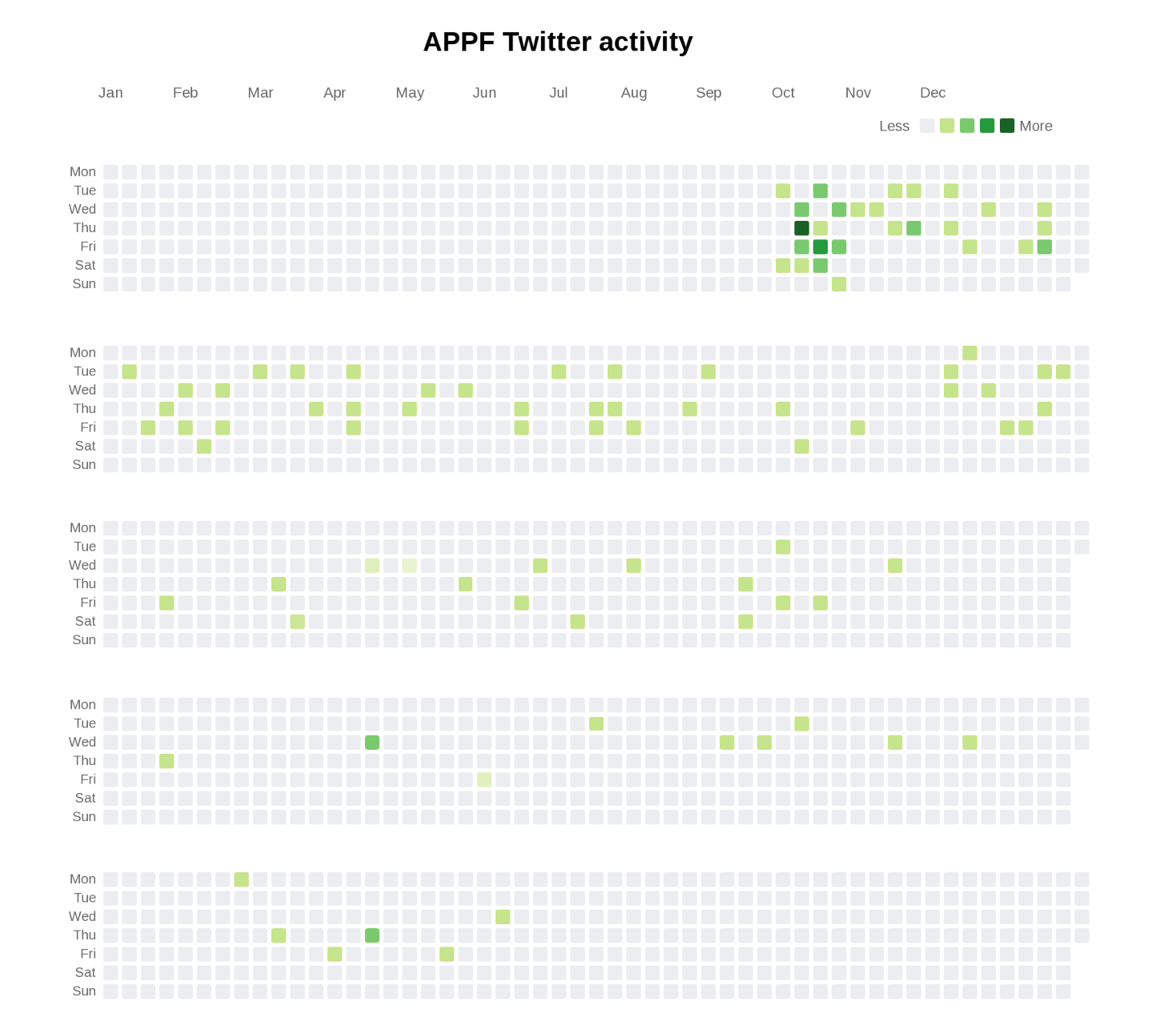
This somewhat silly chart links to a broader issue: European citizens are, by and large, oblivious to the programmes, names, and even existence of their common European political parties.
However, awareness and knowledge of political parties is a crucial precondition for a functioning representative democracy: citizens should be able to recognise the parties that speak and vote in their name, and know what they stand for.
How do we know this lack of awareness? That's the tricky part. Empirical evidence mostly comes from the blank stare on people's faces when you tell about European parties (no, not political groups of the European Parliament).
This fact is also stated time and again in the literature on European parties. See, for instance, International IDEA's 2018 Reconnecting European Political Parties with European Union Citizens, by a collection of leading researchers on European parties.
Unfortunately, actual surveys are difficult to come by, if not entirely nonexistent. So we must rely instead on indirect and less precise hints:
- European parties are barely mentioned by national parties during European elections;
- European parties' logos are hardly visible on national parties' websites, as shown by our own 2021 Logos project, despite this being a requirement under EU law (the Logos Project subsequently led to a change of this requirement in the new Regulation on European parties and foundations);
- political groups remain, by far, the frame of reference for EU politics in the media and for electoral analysis (Politico Europe yields far more results for Renew than for ALDE, and for S&D than for the PES; and platforms such as Europe Elects systematically refer to political groups instead of European parties); and
- individual membership of European parties remains depressingly low — with the European People's Party (EPP) and the Party of European Socialists (PES), the EU's two largest parties, having respectively 23 and 6 individual members — far fewer than their own members of the European Parliament — for a Union of 450 million citizens.
For several years, we at the European Democracy Consulting Stiftung have tried to convince the European Commission and European Parliament to include questions assessing citizens' "awareness and recall" of European parties in their respective Eurobarometers. The idea being to get a periodic snapshot of citizens' familiarity, not with a party in particular, but with European parties in general. Our proposal was met with genuine interest, and never acted upon.
We also called on European institutions to endow the APPF with a mission of public information, as part of our Initiative on Transparency for European party Funding, and to give it sufficient resources for this task. So empowered, the APPF would have a solid legal basis to inform citizens about their parties. But this proposal has so far not been picked up.
In the absence of this legal basis, the APPF has limited itself to the bare minimum. Cue its Twitter account — so far the only social media channel of the APPF. The account boasts an impressive 89 posts, 5 quote posts, and 29 reposts in 1,519 days, or around four years and two months. That is only one post every 17 days, despite the occurrence of the 2024 elections to the European Parliament, during which citizens need even more information on their common parties.
But the trend is even more worrying. Since the beginning of 2024 (once again, a period that includes once-every-five-years elections), the APPF has posted only 27 times, not even a single post per month. And only 14 times since the beginning of 2025, or a post every 41 days. For anyone remotely familiar with social media, this is far insufficient to generate interest, especially on a single platform.
A qualitative review is not more encouraging. In those two-and-a-half years since early 2024, the APPF posted eight times about its school competitions — a very legitimate reason, of course —, and four times about receiving applications for registration by parties and foundations. However, it did not once post about the result of these applications for registration, nor about its recent fact-finding report on the respect for EU values (the first of its kind, enable by a newly-adopted Regulation), nor about the European Parliament's decision to open a verification procedure, nor about the job opening for its own Director, and only had a single quote post regarding a new Regulation on parties and foundations that was over four years in the making.
As a public service, we even created mirrors of the APPF's Twitter account on BlueSky and LinkedIn, in order to help increase the reach of the APPF's own messages. But this effort was only met with a cease and desist order from the APPF. We gladly gave the accounts over, hoping they would be maintained, but they weren't, and the APPF continues to post exclusively on Twitter.
Overall, citizens' continued lack of awareness and knowledge of their common European parties remains a major stumbling block for a healthy representative democracy in at EU level, and European institutions should bear in mind that a progressive increase of Union competences unmatched by a parallel increase in European democracy will lead to a rejection of our Union by its citizens and to a willingness to "take by control" at the national level that the far-right will only be delighted to exploit.
The Treaty on European Union says that European parties "contribute to forming European political awareness and to expressing the will of citizens of the Union" (Art. 10.4); but, in the absence of willingness by national parties and of sustained or sufficient efforts by European institutions, who contributes to citizens' awareness of their own parties?